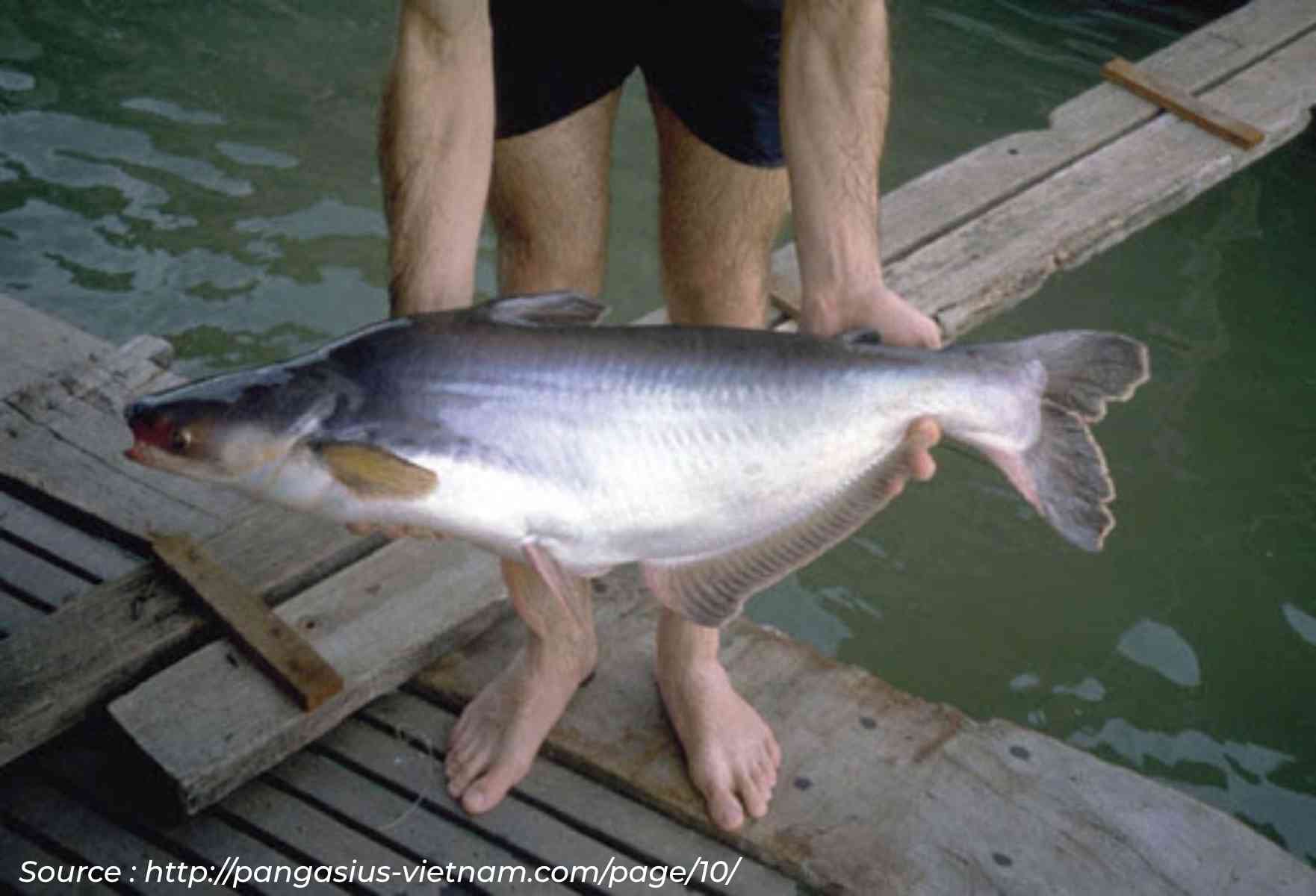

Pangasius is one of the native fish of Indonesian waters that have been successfully domesticated. Many types of Pangasius are almost scattered throughout Indonesian waters. Apart from Indonesia, Pangasius is also found in other Asian regions such as Vietnam, Thailand, and China. There are about 13 species of Pangasius, one of which is Pangasius hypophthalmus which has been successfully cultivated. Pangasius hypophthalmus itself is a fish that comes from Thai waters. Pangasius hypophthalmus fish is also known as djambal siam, bangkok catfish, and bangkok shark. In the language of international trade, it is known as siamese shark, sutchi catfish, or Pangasius. In Indonesia, this fish has only been cultivated since the 1980s. According to Ghufran (2010), the taxonomic position of Pangasius hypophthalmus is as follows
Kingdom : Animalia
Phylum : Chordata
Class : Pisces
Order : Siluriformes
Family : Pangasidae
Genus : Pangasius
Species : Pangasius hypophthalmus.
1. Morphology of Pangasius hypophthalmus
The Pangasius hypophthalmus fish has a relatively long body, which is white like silver with a bluish back and no scales. It has a small head with a mouth at the tip of the head that is slightly downwards. Pangasius is classified as a catfish because they both have no scales. The body length is approximately 120 cm, and the corners of the mouth have two pairs of whiskers that function as tactile organs. There is a tiny fin on the back, and the tail fin forms a symmetrical fork. The fins possessed by this fish are the anal fin, which is quite long and has 30-33 soft rays, and the abdominal fin, which has six soft rays. The pectoral fins have a hard radius that turns into a weapon known as a patil and has 12-13 soft rays
2. Habitat and life habits of Pangasius hypopthalmus
The habitat of Pangasius hypophthalmus is located on the banks of large rivers and estuaries of rivers and lakes. Pangasius hypophthalmus is a nocturnal animal, which is a type of animal that is active at night. This fish likes to hide in caves by the river. The eggs of Pangasius hypophthalmus fish in nature are usually found in groups and occasionally appear on the surface of the water to breathe oxygen directly into the air before dawn. The environment for the cultivation of Pangasius hypophthalmus is not complicated because this fish is a species that can survive in a poor aquatic environment. However, Pangasius hypophthalmus prefers waters with good conditions. When viewed from the shape of its mouth, which is slightly downwards, the Pangasius hypophthalmus fish can be identified as a type of fish that lives on the bottom of the waters.
The survival of Pangasius hypophthalmus fish is strongly influenced by good water quality. The reason is that water is a medium for growth and development, so the water must meet the applicable requirements. There are several factors or indicators for suitable water parameters to use. The following factors are used as parameters in assessing the quality of water as excellent or bad
- Dissolved oxygen (O2) is between 3-7 ppm, optimally 5-6 ppm.
- Temperature 23–33 °C
- Water pH 6.5-9.0 optimal 7-8.5
- Carbon dioxide (CO2) no more than 10 ppm
- Ammonia (NH3) and sulfuric acid (H2S) not more than 0.1 ppm